
Last month, SICO Capital launched the SICO GCC Dividends Fund, its third equity strategy. The fund targets investors seeking sustainable income and long-term capital appreciation through a disciplined, rules-based process that combines quantitative screening with fundamental equity research to identify high-quality dividend-paying companies across the GCC.
This paper explains the investment rationale behind the SICO GCC Dividends Fund, the historical evidence supporting the strategy, and the role of fundamental research in distinguishing sustainable dividend opportunities from yield traps.
The Concept
GCC equity markets have consistently offered some of the highest dividend yields globally, exceeding those of developed and emerging market benchmarks for much of the past decade (Figure 1). Unlike many mature markets where elevated dividend payouts often reflect limited growth opportunities, the GCC presents a distinctive proposition: attractive dividend yields alongside favorable structural growth drivers.
This combination reflects the region’s long-standing preference for cash distributions among local investors, while many listed companies continue to benefit from robust earnings, healthy balance sheets, and strong cash generation.
The central question was straightforward: can a disciplined strategy focused on sustainably high-dividend-yield companies deliver superior long-term returns? Our view was that it could, because companies able to pay attractive dividends consistently are often market leaders with durable competitive advantages, resilient business models, and strong free cash flow generation.
Fig. 1: Dividend Yields of the GCC vs. Major Global Equity Markets
Source: Bloomberg
Testing the Strategy
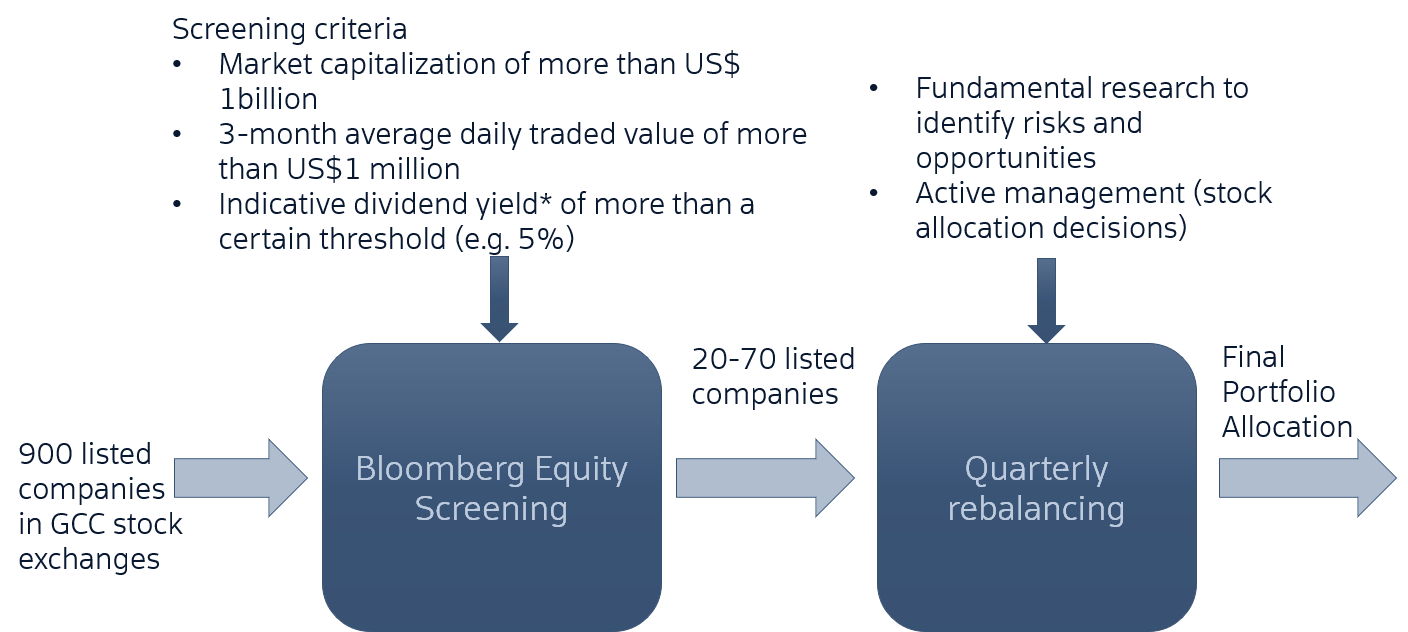
To evaluate the robustness of the strategy, we conducted a 15-year historical back-test covering the period from 2009 to 2024. The investment universe was screened for companies offering dividend yields above 5%, while applying additional market capitalization and liquidity filters to ensure the strategy remained readily investable.
Eligible companies were required to have a market capitalization exceeding US$1 billion and an average daily traded value above US$1 million. We then assessed the strategy under annual, semi-annual, quarterly, and monthly rebalancing frequencies, while also testing a higher dividend yield threshold of 6%.
This framework allowed us to compare not only headline returns, but also the trade-off between performance, portfolio turnover, and implementation practicality.
Compelling Results
The results supported the case for a disciplined high-dividend strategy across the GCC.
Among the strategies tested, a minimum dividend yield of 5% combined with quarterly portfolio rebalancing delivered the strongest balance between return generation and implementation efficiency. Over the 15-year period, the strategy generated an average annual return of 11.2%, outperforming the S&P GCC Total Return Index by 3.8 percentage points per year.
Performance was equally impressive on a risk-adjusted basis, with a Sharpe ratio of 0.92 and an Information Ratio of 0.80. These metrics indicate that the strategy’s excess returns were not simply the result of taking proportionately higher portfolio risk. Although monthly rebalancing marginally improved returns, the significantly higher portfolio turnover would have materially increased transaction costs, making quarterly rebalancing the more efficient approach. Raising the dividend yield threshold to 6% did not produce any meaningful improvement in performance, suggesting that investors need not chase the highest-yielding names to generate superior returns.
Fig. 2: Output of Different Models – Performance Between 2009–2024
| Div yield / rebalancing | 5% / Annual | 5% / Bi-annual | 5% / Quarterly | 5% / Monthly | 6% / Annual |
|---|---|---|---|---|---|
| Portfolio cumulative return, % | 334 | 301 | 390 | 410 | 344 |
| Benchmark cumulative return, % | 191 | 191 | 191 | 191 | 191 |
| Outperformance, % | 143 | 110 | 199 | 219 | 153 |
| Portfolio average yearly return, % | 10.3 | 9.7 | 11.2 | 11.5 | 10.4 |
| Benchmark average yearly return, % | 7.4 | 7.4 | 7.4 | 7.4 | 7.4 |
| Outperformance, % | 2.9 | 2.3 | 3.8 | 4.1 | 3.1 |
| Annual average turnover, % | 48 | 95 | 136 | 240 | 54 |
| Sharpe ratio | 0.82 | 0.79 | 0.92 | 0.93 | 0.94 |
| Information ratio | 0.66 | 0.60 | 0.80 | 0.87 | 0.52 |
| Beta | 0.83 | 0.80 | 0.80 | 0.81 | 0.65 |
| Maximum drawdown, % | -48 | -46 | -44 | -44 | -46 |
Source: Bloomberg, SICO AM
How the Model Portfolio Performed Afterwards
After identifying the optimal framework, we tested the strategy out of sample across 2025 and the first half of 2026.
The strategy continued to outperform. In 2025, it generated a total return of 14.5%, comfortably ahead of the benchmark’s 2.5% gain. Performance was primarily driven by stock selection across Saudi Arabia, the UAE and Oman.
Momentum carried into the first half of 2026, with the portfolio returning 13.8%, outperforming the benchmark by 11.4 percentage points despite heightened market volatility.
Much of the excess return came from systematically adding high-yielding opportunities that had temporarily fallen out of favor. Several Omani companies entered the portfolio at the start of the year and subsequently rallied, while beaten-down UAE names, including Talabat following its March sell-off, also contributed meaningfully to performance.
Fig. 3: Contribution to Outperformance (2025/1H2026)
Source: Bloomberg, SICO AM
Discipline of the Strategy
One of the strategy’s greatest strengths is its systematic discipline.
By adhering to predefined rebalancing rules rather than discretionary decision-making, the portfolio can lock in gains and avoid behavioral biases that often undermine long-term investment performance. For example, the strategy automatically exited several Omani holdings after their strong first-quarter rally in 2026, preserving gains before the subsequent market correction.
Similarly, periods of heightened market uncertainty often create attractive opportunities among fundamentally sound dividend-paying companies. During the initial stages of the Middle East conflict, the sharp decline in UAE equities increased the number of qualifying high-yield stocks entering the portfolio—opportunities that discretionary managers may have overlooked amid prevailing market pessimism.
How Deeper Fundamental Analysis Adds Value
While the quantitative framework provides a robust foundation, we believe integrating bottom-up fundamental research can further enhance long-term returns.
A purely rules-based approach cannot always distinguish between attractive dividend opportunities from value traps. Dividend sustainability can deteriorate because of weakening fundamentals, changing capital allocation priorities or company-specific risks.
Humansoft Holding provides a good example, where declining enrolments and rising costs have weakened earnings prospects and, by extension, future dividend-paying capacity. Likewise, changes in dividend policy—such as Emaar’s revised payout framework announced in late 2024—may not be immediately reflected in quantitative screens. In other cases, unusually high dividend yields may simply reflect elevated market concerns relating to governance, litigation, or financial distress.
Fundamental analysis therefore serves as an important second layer of risk management, helping distinguish genuinely attractive income opportunities from companies where elevated yields signal deteriorating fundamentals.
Fig. 4: The Investment Process
Our research demonstrates that a disciplined high-dividend investment strategy has historically delivered consistent outperformance across GCC equity markets while maintaining attractive risk-adjusted returns. When combined with rigorous fundamental analysis, we believe the approach is well positioned to identify high-quality businesses capable of generating sustainable income and long-term capital appreciation for investors.